
The Moth-Proof Australian Home
A complete guide to building a sanctuary that keeps winged invaders outside where they belong
Building a new home in Australia is one of the most exciting journeys you will ever undertake. You spend months dreaming about open-plan living areas, natural light pouring through floor-to-ceiling windows, and seamless indoor-outdoor entertainment areas. However, for many prospective homeowners, there is a quiet worry that can quickly turn a dream lifestyle into a constant battle: Australian insects, and specifically, moths.
Australia is famous for its vast wilderness, but it is equally famous for its vibrant bug life. If you have ever lived in a house where dozens of moths flutter around your television screen at night, drop into your water glasses, or flutter frantically against your bedside lamp, you know how frustrating they can be. Even worse is discovering that tiny closet invaders have chewed through your favorite wool sweater, or that pantry pests have infested your dry baking ingredients.
UNDERSTANDING AUSTRALIA'S UNIQUE MOTH PROBLEM
To keep your future home completely moth-free, it helps to know what you are actually up against. In Australia, moth problems generally fall into two distinct categories: massive outdoor invasions and stealthy indoor pests.
1. The Outdoor Swarmers: The Legendary Bogong Moth
Every year during spring and early summer, millions of native Bogong moths embark on a massive migration from their breeding grounds in Queensland and western New South Wales down toward the Australian Alps. Along their travel route, which passes directly through major metropolitan areas and rural towns alike, these moths are heavily drawn to artificial lights. When migrating Bogongs hit suburban areas, they look for dark, cool crevices to hide in during the daylight hours. They squeeze under front doors, crawl through sub-floor vents, slip through weep holes in brickwork, and settle into roof spaces by the thousands. When night falls, indoor lighting acts like a powerful magnet, pulling them right into your living room through any available opening.
2. The Indoor Invaders: Clothes and Pantry Moths
While Bogong moths are harmless to your belongings and simply annoying to look at, domestic moths are an entirely different story. Case-bearing clothes moths and webbing clothes moths do not care about light; they care about dark, undisturbed spaces rich in natural fibers like wool, silk, feathers, and cotton. On the other hand, Indian meal moths (commonly known as pantry moths) seek out flour, cereal, nuts, and pet food to lay their eggs.
The Core Rule of Moth-Free Building: A truly moth-proof home must combine physical exterior sealing to stop migrating swarms with smart interior design to eliminate the dark, humid breeding zones that domestic moths love.
Why Standard Homes Fail to Keep Moths Out
Most standard houses built across Australia are constructed with basic pest management in mind—usually focused on termites or standard flies. They are not engineered to be insect-tight. Standard builders routinely install window flyscreens with mesh grids that are far too wide, leaving gaps around sliding door tracks, unsealed roof gaps, and open weep holes.
Furthermore, traditional outdoor spotlight positioning places bright white bulbs directly above entrance doors. This design effectively invites migrating insects to wait right at your doorstep, ready to zip inside the second you step through the entrance.
Pillar 1: Physical Exclusion & Exterior Barrier Protection
The first line of defense is creating a complete physical shield around your house. If an insect cannot physically enter your building envelope, you will never have to worry about swatting them inside.
Ultra-Fine Micro-Mesh Flyscreens
Standard flyscreen wire installed on standard window frames is designed to block large flies and mosquitoes. However, smaller species of moths, or young moths seeking shelter, can easily squeeze right through those standard square gaps. When designing your custom build, specify ultra-fine stainless steel woven mesh (often referred to as marine-grade 316 mesh).
This micro-mesh features sub-millimeter openings. It stops even tiny insects dead in their tracks while still allowing fresh sea breezes and natural ventilation to flow freely through your living space. Furthermore, stainless steel mesh does not sag, melt, or tear over time like cheap nylon screening.
Precision Weather-Sealing on All Entry Doors
Have you ever noticed a tiny sliver of light beneath your front door at night? To a moth, that sliver of light is an open invitation. Moths are naturally drawn to light escaping from inside your house, and they are expert crawlers that will flatten themselves to slide under door gaps.
To eliminate this vulnerability, your home should be built with perimeter rubber gaskets on all external door frames and fitted with automatic drop-down door bottom sweeps. These drop-down sweeps are mechanical seals concealed inside the bottom of the door. The moment the door swings shut, a rubber seal automatically drops down flush against the threshold, leaving zero clearance for crawling insects.
Weep Hole Mesh Protectors and Vent Screens
Brick homes in Australia require "weep holes"—small vertical gaps left between bricks near the foundation and above windows to allow trapped moisture to drain out and air to circulate. Unfortunately, weep holes are essentially open highways for migrating Bogong moths looking for a dark cavity to rest in.
Instead of leaving these holes open, insist on installing specialized stainless steel weep hole covers (such as Weepa protectors) during the bricklaying phase. These covers allow water and air to escape as designed, but feature fine grills that block insects completely. Additionally, all eave vents, soffit openings, and sub-floor ventilation points must be backed with durable stainless steel mesh screens before the roof and exterior walls are fully closed in.
Pillar 2: Lighting Science & Attraction Management
You can build the strongest physical walls, but if your home glows like a lighthouse in the dark, swarms of moths will gather around your windows every spring. Light management is a subtle, non-intrusive science that drastically reduces the number of insects that ever approach your walls.
Understanding Insect Vision: Spectrum Shift
Insects do not see light the same way humans do. Moths are particularly sensitive to ultraviolet (UV) light, cool blue light, and bright white light. Traditional outdoor halogen lights or cool-white LED floodlights emit heavy blue and UV wavelengths that attract insects from hundreds of meters away.
By specifying warm amber LED lighting (wavelengths above 590 nanometers, or color temperatures between 2200K and 2700K) for all exterior fixtures, your house becomes virtually invisible to migrating moths. Amber light provides warm, elegant illumination for human eyes while remaining entirely outside the primary visual spectrum of nocturnal insects.
Strategic Light Fixture Placement
Where you place your light fixtures matters just as much as the bulb type. Instead of mounting powerful wall sconces directly beside your entry doors, position ground-mounted garden lights or bollard lighting slightly away from pathways, directing light downward toward the ground. This keeps any residual insect activity focused on your garden beds rather than near your front door or outdoor dining space.
Pillar 3: Climate Control & Air Pressure Management
The interior atmosphere of your home plays a massive role in discouraging pest activity. By controlling humidity and air movements, you turn your indoor living environment into a place where moths simply cannot settle or reproduce.
Fully Sealed Air Conditioning with Positive Pressure Intake
Many traditional homes feature older-style ducted evaporative cooling systems or simple roof exhaust fans. When these systems are turned off, their open louvers and unsealed ductwork become prime entry routes for fluttering pests. A moth-proof design relies on a fully sealed, reverse-cycle ducted heating and cooling system.
By incorporating fresh-air intake units fitted with high-efficiency filters (HEPA filters), your HVAC system creates slight positive air pressure inside your home. This means that whenever an exterior door opens briefly, air pushes outward rather than sucking outdoor air (and flying bugs) into your living room.
Integrated Humidity Control
Domestic moths—especially clothes moths and pantry pests—require ambient moisture to thrive. They love damp, dark, stagnant environments like humid laundry rooms, unventilated walk-in robes, and dark kitchen corners. Keeping your home's relative indoor humidity below 50% stops moth larvae development in its tracks.
Pillar 4: Interior Joinery, Flooring, & Storage Features
Even in the tightest building envelopes, a stray moth might occasionally enter through an open entry door while you bring in groceries. What happens after an insect enters comes down entirely to your interior design choices.
Hard Surface Flooring Over Wool Carpets
Wall-to-wall wool carpeting is a traditional favorite for bedroom floors, but it is also the primary breeding ground for clothes moth larvae. Larvae feed on keratin—a protein found in natural animal fibers like wool. They thrive underneath heavy beds, along baseboards, and behind dressers where vacuum cleaners rarely reach.
Design Tip: Opt for hard-surface flooring throughout your floor plan—such as polished concrete, engineered timber, or luxury porcelain tiles. If you love soft textures underfoot, use washable area rugs made from synthetic fibers or easily cleanable natural cotton that can be regularly moved and laundered.
Aromatic Cedar-Lined Wardrobes with Rubber Seals
Custom wardrobes should be treated as secure storage vaults for your garments. Rather than open-shelf wardrobe systems or simple sliding doors with open side gaps, build custom cabinetry featuring perimeter rubber gaskets that seal airtight when closed. Lining closet interiors with natural aromatic Western Red Cedar provides an organic natural deterrent, as the natural oils in cedar wood repel moth larvae while giving your closet a luxurious timber fragrance.
Non-Porous Pantry Joinery
Pantry moths lay their eggs in the tiny cracks, shelf pin holes, and unsealed timber joints of kitchen cabinets where flour dust collects. Specifying fully sealed, non-porous joinery materials like seamless high-pressure laminate or acrylic cabinet interiors leaves zero food-dust traps, making kitchen cleanup effortless and keeping food storage areas pristine.
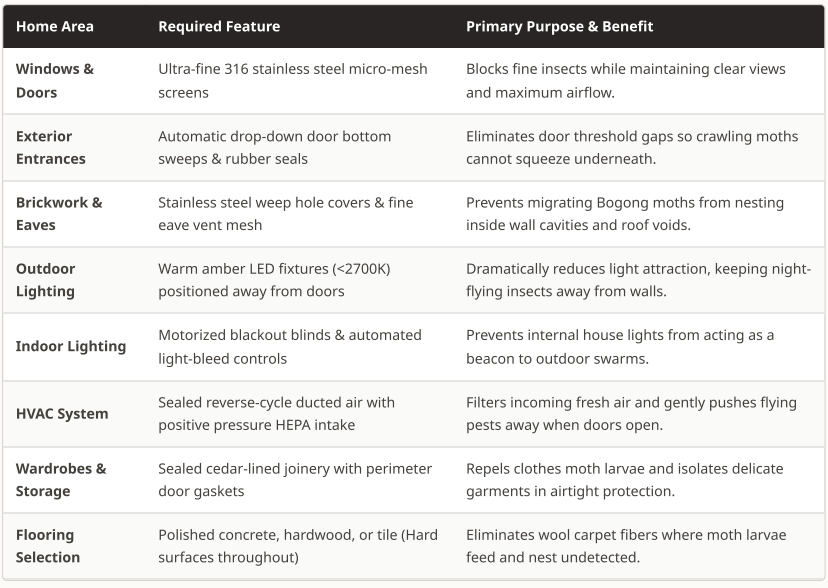
Feature Summary: The Moth-Proof Construction Checklist
Turn Your Moth-Free Vision into Reality
Building a home in Australia should be a joyful experience, free from the annoyance of fluttering pests, ruined wardrobe items, or ruined pantry goods. Achieving a 100% insect-resistant living environment does not mean compromising on modern luxury, natural sunlight, or beautiful open-plan designs—it simply requires thoughtful planning, smart architectural choices, and precision craftsmanship.
At Custom Home Creations, we specialize in translating your unique lifestyle priorities into beautifully engineered custom homes. Whether you want an insect-tight sanctuary, an eco-friendly energy-efficient design, or a luxury architectural masterpiece built for the Australian climate, our expert design team knows exactly how to build it right from the ground up.
Ready to Build Your Perfect Insect-Tight Sanctuary?
Don't settle for standard builder plans that leave your future home vulnerable to pests. Speak with our master design specialists today to learn how we can integrate specialized pest-proofing features seamlessly into your custom floor plan.
[Contact Custom Home Creations Today]